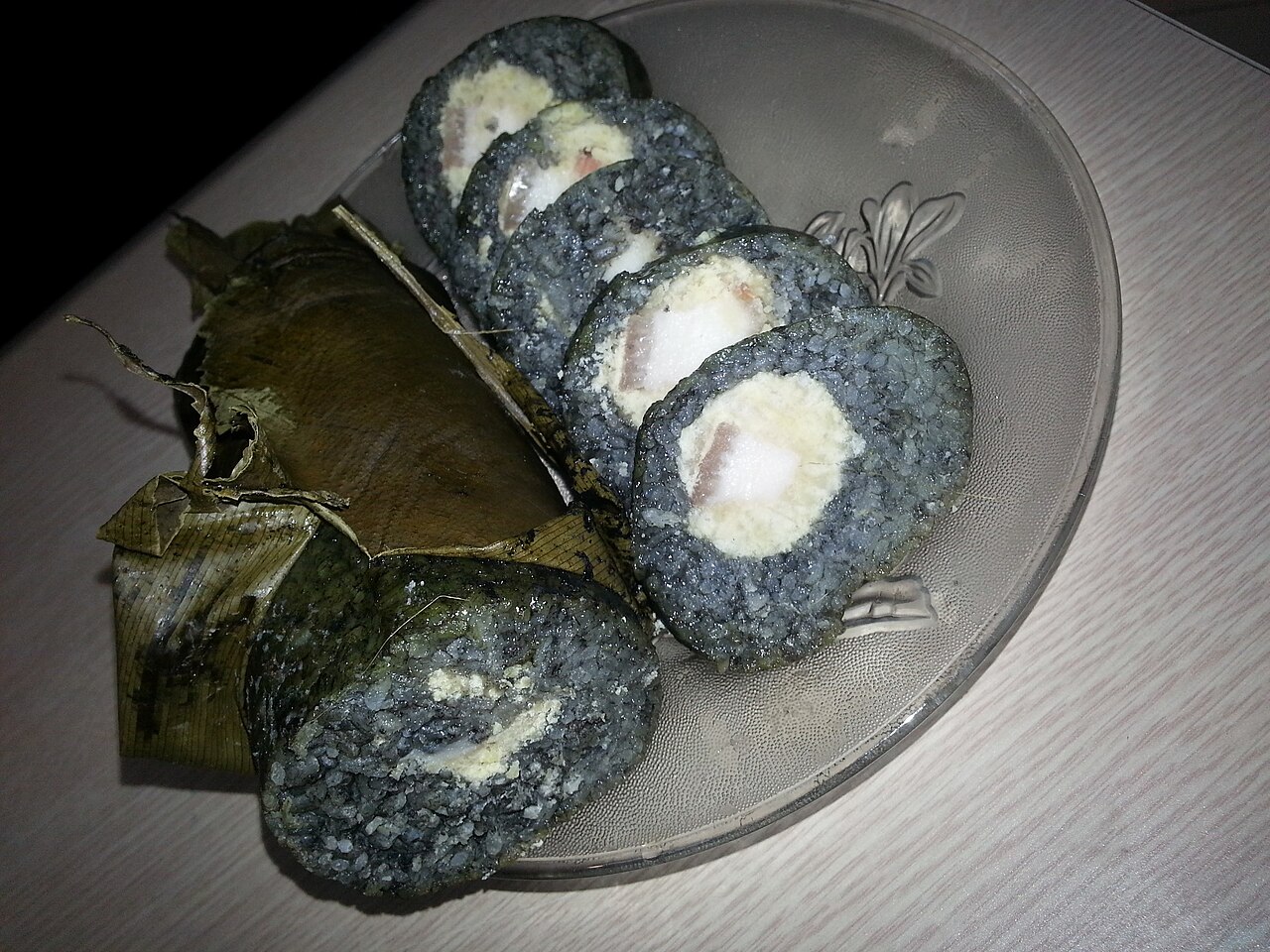
At market stalls on the eve of a festival, glossy black rice cakes are stacked up like small hills. Peel back the leaf wrapping and glistening black sticky rice reveals a savory filling inside -- this distinctive-looking rice cake is a Tày tradition, but to taste the most authentic version, you'll need to travel to Huyện Bảo Lạc in western Cao Bằng.
Cross-confirmed by Vietnamese Wikipedia and state media as a traditional Tày festival rice dish
Vietnamese Wikipedia has a standalone entry for this dish. Mainstream news outlet Tiền Phong's Hanoi edition and state-run Vietnam News Agency cross-confirm that black bánh chưng is a traditional Tày and Thái rice dish, made by dyeing sticky rice black with ash burned from rice stalks, tree branches, or black sesame flowers, then steaming it -- a common rice dish during festivals. Sources describe the specific tree species used for the ash somewhat inconsistently, and this entry doesn't adopt any single version as definitive.
Honest clarification: the core region is Huyện Bảo Lạc, and similar black bánh chưng are also found in Lạng Sơn, Yên Bái, and other provinces
A double honest disclosure has to be made here. First, verification within Cao Bằng province clearly centers this dish on Tày communities in Huyện Bảo Lạc -- the core region isn't within Cao Bằng City's own territory. Second, this is a traditional rice dish shared across the Tày and Thái peoples in multiple provinces; similar black bánh chưng are also found in Lạng Sơn, Yên Bái, Lào Cai (including Huyện Bắc Hà), and Nghệ An -- it isn't unique to Cao Bằng. Following this guide's consistent approach, this entry keeps the item, since black bánh chưng is still widely available as a souvenir at the city's markets and during festivals, while honestly disclosing both points of overlap above, rather than overstating it as a Cao Bằng original.
How to Eat It Like a Local
- Around festival time, Cao Bằng City's markets are the easiest place to buy ready-made black bánh chưng to take home as a souvenir.
- For the most authentic version, plan a trip to a Tày community in Huyện Bảo Lạc.
- The traditional way to eat it is sliced with a soy-sauce dip, or plain, to take in the fragrance of the sticky rice and leaf wrapping.
An Honest Look at This Rice Cake's Origins
- Verification within Cao Bằng province clearly centers this dish on Tày communities in Huyện Bảo Lạc -- the core region isn't within Cao Bằng City's own territory.
- Similar black bánh chưng are also found in Lạng Sơn, Yên Bái, Lào Cai, and Nghệ An -- this isn't a Cao Bằng original.
- Sources describe the specific tree species used for the ash inconsistently -- this entry doesn't force them into a single version.
Peel back the black leaf wrapping and the fragrance of sticky rice rises up -- this rice cake doesn't hold any one place's exclusive secret, but a shared memory the Tày and Thái peoples wrote with ash and sticky rice across several provinces.