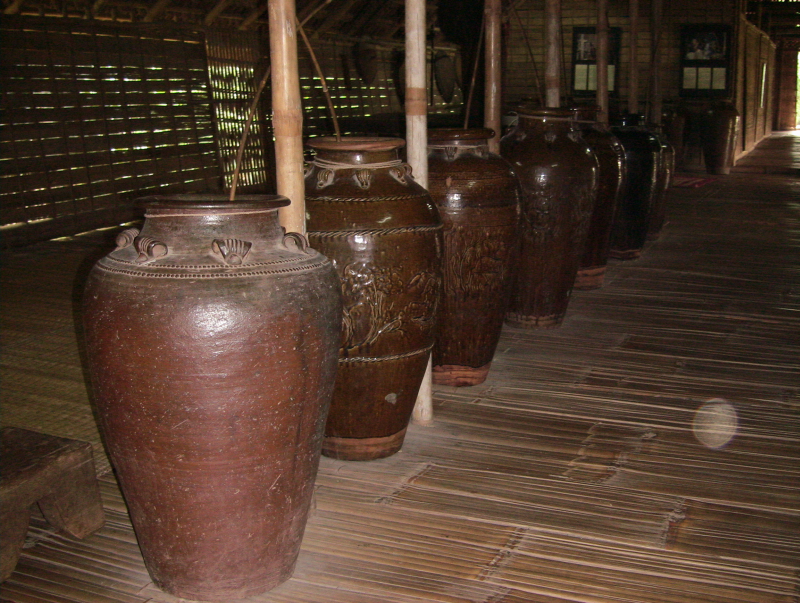
In front of the traditional stilt houses of Buôn Akô Dhông village, a clay jar sits at the center of a bamboo mat, a bamboo straw more than a meter long propped in its mouth. Guests take turns leaning in to sip, the mildly sour-sweet taste of fermented glutinous rice flowing slowly through the straw — this is jar wine, an indispensable ceremonial rice wine for the Ê Đê people's welcoming rituals, worship, and weddings.
State media and the provincial museum detail the ritual culture; the village itself has been called "the most beautiful village in the Central Highlands"
The Vietnamese Wikipedia entry "Buôn Akô Dhông" records that this village was founded by the Ê Đê people in 1956 and still has 32 traditional stilt houses standing, called "the most beautiful village in the Central Highlands" by outlets including vietnamnet.vn. State outlet Nhân Dân (the Communist Party's central organ) ran a dedicated feature, "Nét đẹp văn hóa rượu cần," VOV.vn also reported that this type of buôn (village) is among the most representative sites for preserving Ê Đê culture within Buon Ma Thuot city, and the official Đắk Lắk Museum site has a dedicated feature, "Văn hóa uống rượu cần của người Êđê," detailing the jar wine ritual and how the drinking straws are made.
Honest clarification: jar wine is a shared tradition across multiple Central Highlands ethnic groups, not a Buon Ma Thuot original
Jar wine is glutinous rice fermented with forest herbs in a clay jar for at least a month, reaching about 15–25% alcohol by volume, and drunk by sipping through a bamboo straw 1.2 to 1.5 meters long rather than pouring into cups. It has to be said honestly that jar wine isn't unique to Buon Ma Thuot — northwestern Vietnam (the Mường people of Hòa Bình, Sơn La, and elsewhere) and various Central Highlands ethnic groups (M'nông, Ê Đê, Bahnar, and others) each have their own versions. This guide represents only the Central Highlands / Ê Đê branch, not a Buon Ma Thuot original invention. In addition, while Buôn Akô Dhông village retains its traditional stilt-house scenery, it's now highly touristed — several restaurants inside the village offer paid, experience-style jar wine tastings and stilt-house visits, rather than a random slice of everyday village life.
How to Experience It Authentically
- Most tastings require a paid booking at a restaurant in Buôn Akô Dhông village — not something you'd randomly stumble across.
- The traditional way is for a group to take turns sipping the same jar through the straw, symbolizing shared welcome.
- Fermented for at least a month, it carries a distinct sour-sweet body at about 15–25% ABV — worth noting.
An Honest Look at This Drink's Cultural Standing
- Jar wine is a tradition shared across Central Highlands ethnic groups, not an invention unique to Buon Ma Thuot or the Ê Đê.
- The Mường people of northwestern Vietnam and others have their own versions of jar wine too.
- Buôn Akô Dhông village is now highly touristed, with most experiences being paid rather than everyday village life.
A bamboo straw sunk into a clay jar draws up the shared welcoming wisdom of several Central Highlands ethnic groups. Buôn Akô Dhông village, with its 32 stilt houses, gives this culture a window for display — but honestly, this drink's story belongs to the whole Central Highlands, not to Buon Ma Thuot alone.