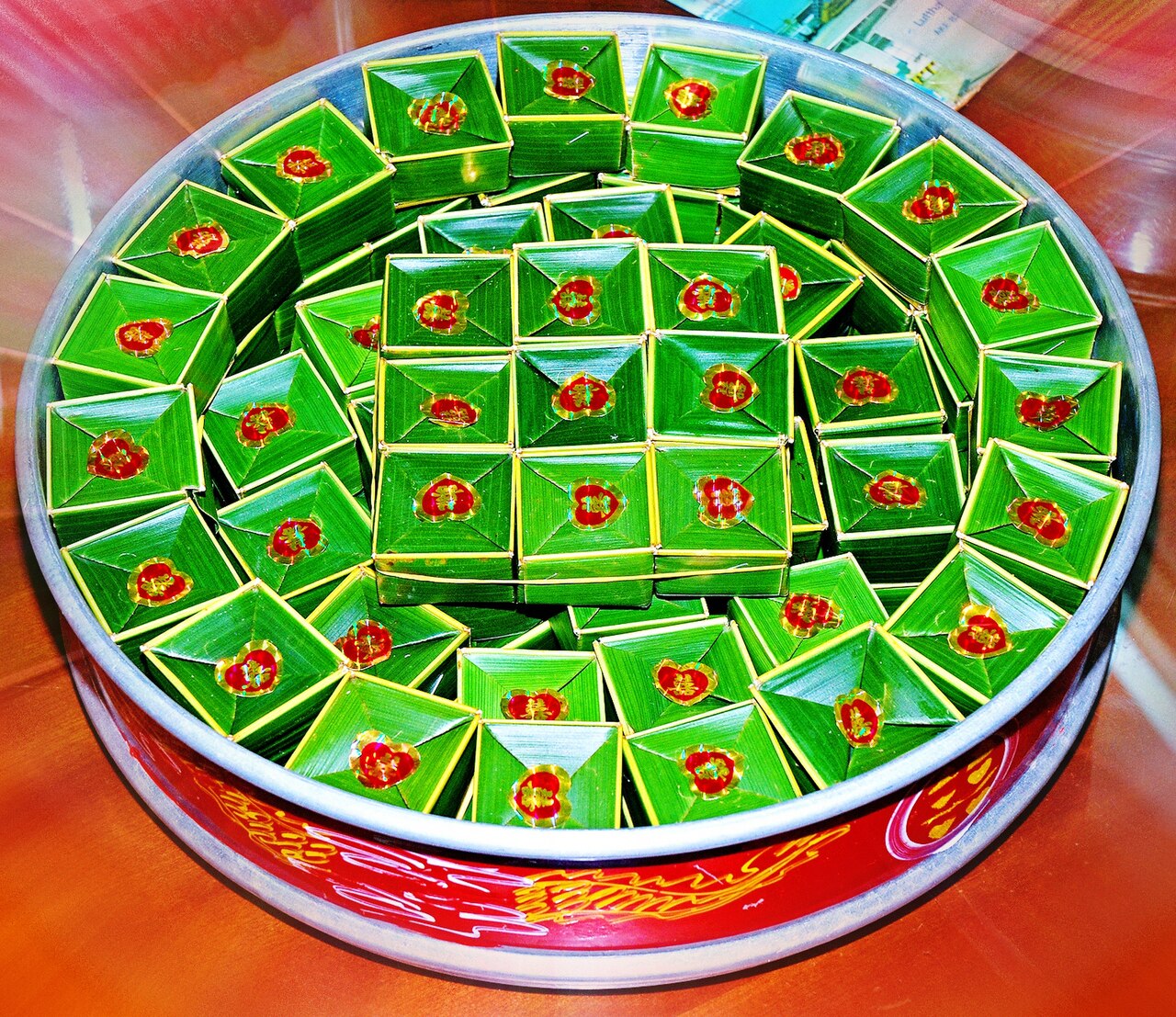
At a souvenir stall in downtown Bắc Ninh City, square packets of sticky rice cake wrapped in oiled paper sit stacked in neat rows, and the vendor can recite the legend behind the name "husband-wife cake" without missing a beat. It's the single most recognizable dish symbol across all of Bắc Ninh, often mentioned alongside phở and water puppetry as representative of Bắc Ninh culture -- but the ground it's truly rooted in lies out in Từ Sơn town, beyond the city.
Cross-confirmed by VnExpress, the People's Army Newspaper, and the national tourism authority as Bắc Ninh's top symbol
Multiple independent VnExpress features, the People's Army Newspaper (qdnd.vn), and the Vietnam National Administration of Tourism's rural tourism website (nongthon.vietnamtourism.gov.vn) all cross-confirm this dish. It's made by wrapping sticky rice flour around a mung bean and shredded coconut filling and steaming it, giving a soft, chewy texture with a coconut aroma. Packaged in matched pairs, it's the single most nationally recognized dish symbol from Bắc Ninh, the sweet visitors most commonly think of as "representative of Bắc Ninh."
Honest clarification: the true origin is Đình Bảng ward in Từ Sơn town, and the queen legend has no historical verification
It has to be said honestly that this cake's true origin is Đình Bảng ward in Từ Sơn town, not within Bắc Ninh City's own territory. This entry's coordinate anchor is placed instead at a representative market and souvenir-shop location confirmed within the city, honestly disclosing this rather than overstating the dish as a Bắc Ninh City original. As for the origin legend -- that a queen during the reign of Lý Anh Tông personally made this cake by hand and sent it to her husband at the border, giving it the name "husband-wife" -- multiple sources repeat the same version, but no independent historical record cross-verifies an exact date. This entry doesn't adopt a specific year, and honestly notes this as a widely circulated but unverified local legend.
How to Eat It Like a Local
- Widely sold at central markets and souvenir shops in Bắc Ninh City -- a good last-minute purchase before leaving.
- The traditional way to enjoy it is with a pot of hot tea, savoring the layered texture of sticky rice and coconut.
- To trace it back to the source, plan a trip out to Đình Bảng ward in Từ Sơn town.
An Honest Look at This Cake's Origins
- The true origin is Đình Bảng ward in Từ Sơn town, not within Bắc Ninh City's own territory -- this entry's anchor uses a city-territory point of sale instead.
- The legend of a Lý Anh Tông-era queen making this cake by hand is repeated across multiple sources, but no independent historical record confirms an exact date.
- Its nationwide fame makes it visitors' go-to "representative Bắc Ninh dessert," but that fame doesn't mean its true origin lies within the city's own territory.
Unwrap the oiled paper and bite into the soft, coconut-scented cake -- its fame has spread across the whole country, but its true hometown has always been Đình Bảng ward, out beyond the city.