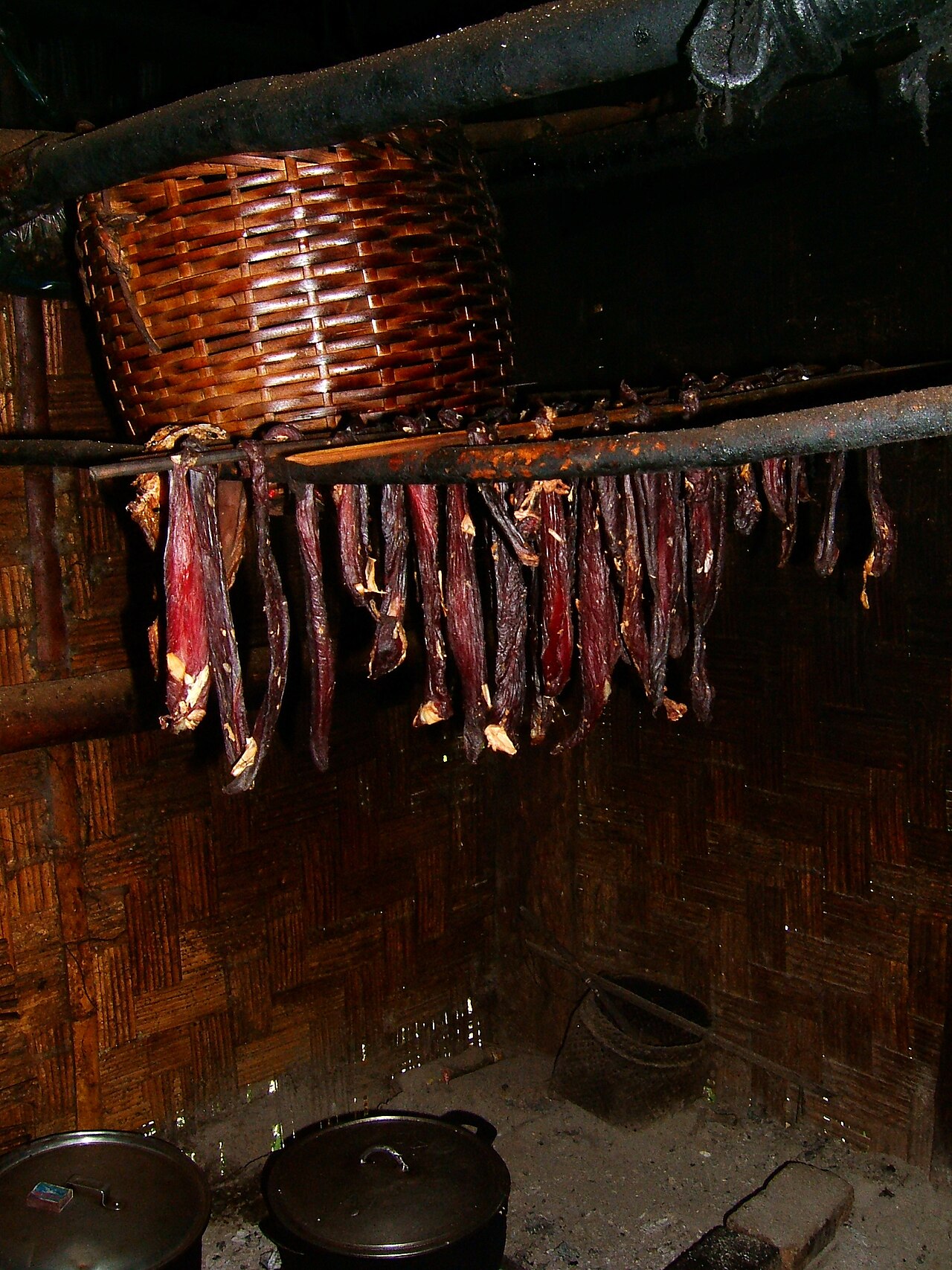
Above the stove, strips of beef hang suspended, thoroughly smoked over time by wood-fire smoke, the meat firm and carrying a smoky aroma. This is the old wisdom of highland households preserving meat -- and Cao Bằng's version keeps its secret in a mountain ginger found only here.
Cross-confirmed by state media as a Cao Bằng gateway specialty, distinguished by local mountain ginger seasoning
Cao Bằng's official provincial party newspaper and state media outlet daidoanket.vn, the official outlet of the Vietnam Fatherland Front, cross-confirm this dish. daidoanket.vn's original text opens explicitly with "come to the Cao Bằng region and try smoked beef," without singling out any other district -- this entry judges there to be no conflict with Cao Bằng City's own territory, and as the gateway city, Cao Bằng City sells it widely at markets and downtown shops. The method marinates strips of beef or water-buffalo meat, then hangs them above a stove to smoke and dry over a long period over wood fire. This dish is seasoned with a local Cao Bằng ginger variety, "khinh phja" (mountain ginger), which serves as the distinguishing point from similar jerky elsewhere.
Honest clarification: smoked beef jerky is a tradition shared across the highland provinces of Vietnam's northwest and northeast -- not unique to Cao Bằng
It has to be said honestly that smoked beef or water-buffalo jerky is a preserved-meat tradition common across the highland provinces of Vietnam's northwest and northeast -- Sơn La, Điện Biên, and Hà Giang provinces are also well known for it, and it isn't unique to Cao Bằng. Worth noting for comparison: this guide's Sa Pa city entry, for its own similar beef jerky, already honestly discloses that it "originates from the wisdom of the Black Thái people, commonly found across the entire northwestern highlands including Sơn La, Điện Biên, and Hà Giang, not unique to Sa Pa -- Sa Pa is simply one active hub of the tourist-souvenir market." This entry follows that same consistent approach to honest disclosure. Sources describe the exact number of smoking days somewhat inconsistently -- "2-3 days" and "15-20 days" both appear, and the former may describe an initial process step while the latter may refer to the full curing-and-aging process -- this entry doesn't force them into a single figure.
How to Eat It Like a Local
- Widely sold at gateway markets and shops in Cao Bằng City -- a good souvenir for a long trip home.
- The traditional way to eat it is torn into thin shreds, dipped in chili salt or eaten plain, to take in the smoky aroma.
- When buying, check the meat's color and degree of smoking to judge whether the drying process was done well.
An Honest Look at This Jerky's Origins
- Smoked beef jerky is a preserved-meat tradition shared across the highland provinces of Vietnam's northwest and northeast -- it isn't unique to Cao Bằng.
- This guide's similar Sa Pa entry has already honestly disclosed a comparable situation -- this entry follows that same consistent approach.
- Sources describe the number of smoking days inconsistently -- this entry doesn't force them into a single figure, presenting the discrepancy honestly.
Tear off a shred of smoked beef jerky and put it in the mouth -- the mountain ginger's spicy warmth mingles with the wood-smoke flavor and spreads across the tongue. This jerky might be found all across the northwestern highlands, but the flavor Cao Bằng locals coax out with their own mountain ginger is the one travelers always remember.