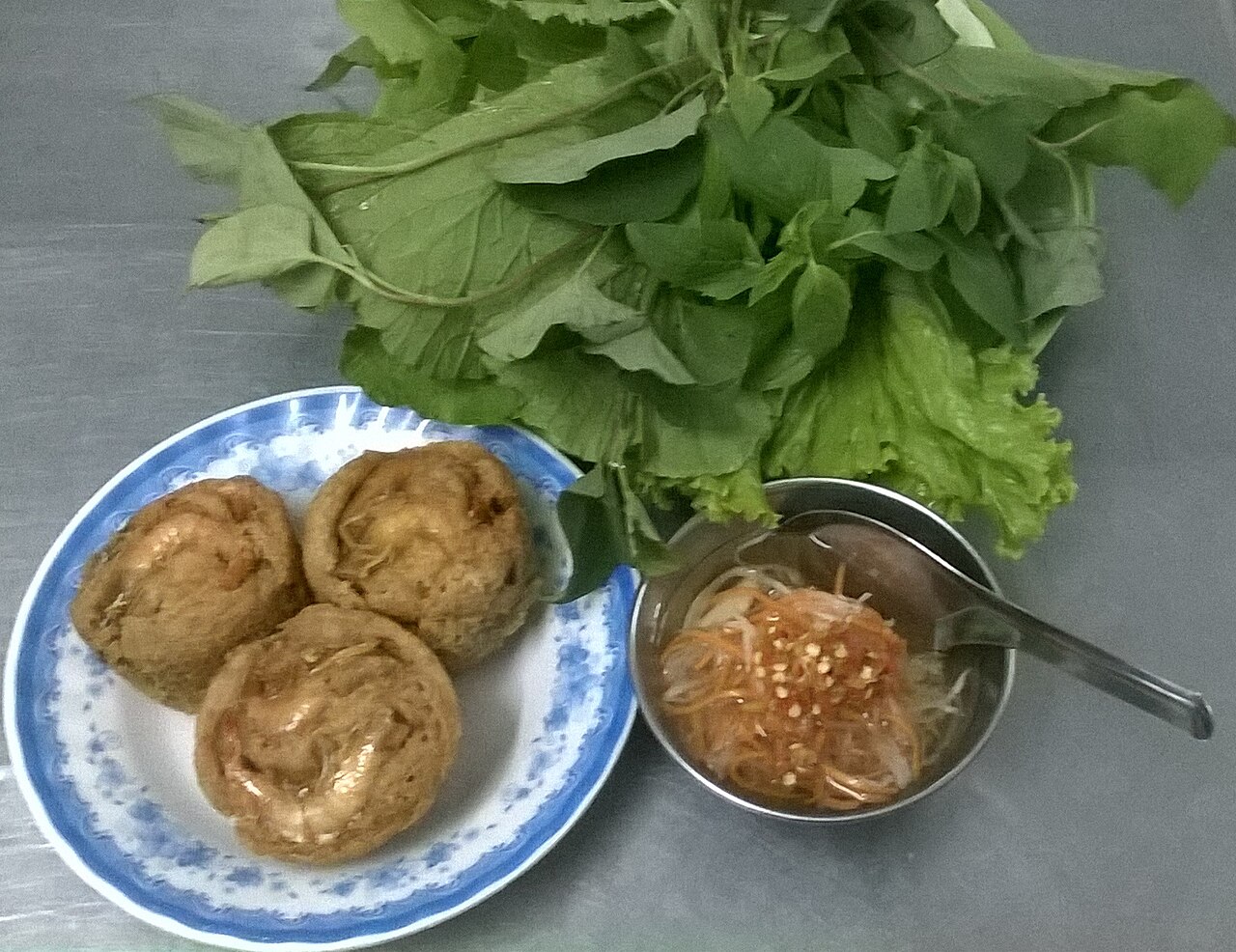
At the Bà Út Lư stall on 3/2 Street, a pot of oil bubbles away. The owner ladles a batter mixed with mung beans and rice flour into a special mold, tops it with a whole shrimp, and fries it until golden and crisp — this is bánh cống, a snack Cần Thơ locals have grown up eating. Crisp on the outside, soft and fragrant with mung bean on the inside, eaten in a bite with lettuce and sweet-and-sour fish sauce, it's one of the most iconic street snacks of the southwestern Mekong Delta. At this stall, open for more than thirty years, most people lining up are regulars.
What is bánh cống, and where does it come from?
Bánh cống is documented in the Vietnamese Wikipedia entry for 'Bánh cống' as a signature southwestern snack, and it has been featured in the Vietnam Fisheries Magazine (Tạp chí Thủy sản Việt Nam) as well as numerous mainstream travel outlets. There's actually more than one origin story: one holds that it derives from a traditional Khmer fried cake, later adapted by Chinese immigrants into the filled version common today; another points to Phong Điền District in Cần Thơ as its birthplace. Neither account has a single authoritative source that settles the matter. Honestly, this snack's origin story remains a matter of differing accounts to this day — this guide presents both versions as they are, without forcing a single answer.
As for the name 'cống,' it actually has nothing to do with a place name — it comes from the mold used to make it, shaped like a short length of pipe or a filter cup. Vietnamese speakers simply named the dish after the shape of the mold, a very down-to-earth naming logic.
How to eat it like a local
Notable shops and local knowledge
Bà Út Lư on 3/2 Street is the area's longest-running shop, open for more than thirty years with a claimed family recipe, and it's a benchmark for many locals. Worth noting: this snack can be found all over Cần Thơ and isn't exclusive to any one shop — if you spot a stall with a long line in another neighborhood, it's worth stopping to compare.
Prices and Hours
- A serving of bánh cống costs about 10,000–20,000 VND (roughly NT$12–24) — a relatively affordable street snack.
- Most stalls do their best business in the evening — go after 4 p.m. for a better chance of getting it fresh off the fryer.
- Try saying: 'Cho tôi hai cái bánh cống.' (Give me two bánh cống.)
Things to Keep in Mind
- The origin story varies widely — don't let a single stall's marketing story convince you it's the definitive answer. Both the Khmer-origin and Phong Điền-origin theories remain unsettled.
- The lettuce and dipping sauce are essential to this dish — don't focus solely on the fried cake itself and skip the wrapping step.
- Hygiene standards vary among street stalls — choosing a busy one with fast turnover generally means fresher ingredients.
A mold's shape decided the name, a single shrimp decided the presentation. This southwestern snack, with its murky origin story, doesn't rely on pedigree — just thirty years of steady oil and fire.