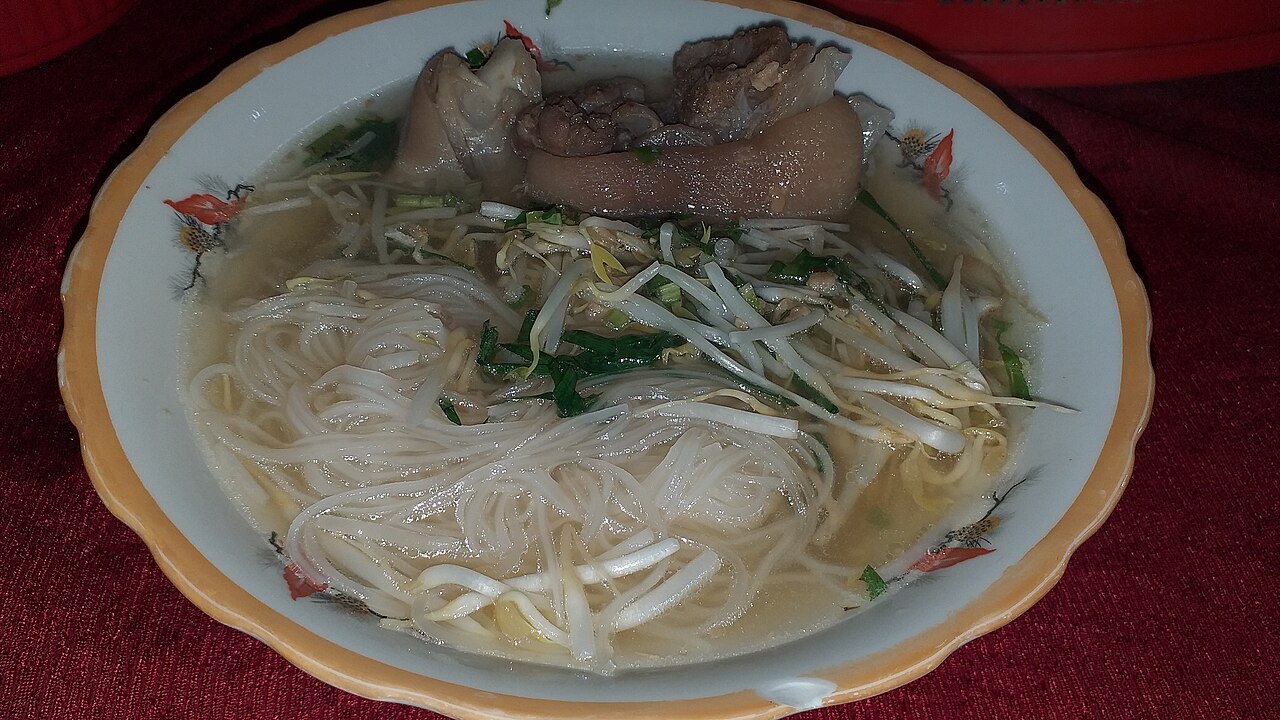
At first light, the hủ tiếu stalls on Quang Trung Street in Ninh Kiều District already have their stoves going. Flat rice noodles are scalded in boiling broth, then topped with sliced pork, shrimp, pork liver, and crispy fried garlic — a steaming bowl of hủ tiếu ready to serve. Mornings in Cần Thơ often start with this bowl: a broth that's light with a hint of sweetness, toppings you can customize as generously or as simply as you like. It's one of the most everyday, most 'local' breakfast options in this gateway city of the Mekong Delta. A cluster of shops open for more than thirty years line Quang Trung Street, and most of the people queuing up are regulars who know the ropes, not tourists chasing a food trend.
What is hủ tiếu, and how did it travel from Teochew to Cần Thơ?
The prototype of hủ tiếu is the flat rice noodle brought to southern Vietnam by Teochew immigrants — the same 'kway teow' familiar across Southeast Asia's Chinese communities. The Chinese Wikipedia entry on kway teow (romanized from its Chinese name as 'guo tiao') documents how this flat rice noodle developed different lineages and preparations across Teochew, Cantonese, and Southeast Asian communities. The Vietnamese version was largely popularized by Chinese immigrants in Saigon's Chợ Lớn district around the 1950s–60s, before gradually spreading to cities across southern Vietnam. To be honest, hủ tiếu is not a Cần Thơ original — Cần Thơ is simply one of many cities where this noodle dish is widely eaten, not its birthplace. That's a point worth clarifying up front in this guide, to avoid perpetuating a myth.
But Cần Thơ does have a hủ tiếu story of its own — not in the toppings or broth, but in the craft of the 'hủ tiếu workshop' (lò hủ tiếu). A number of traditional noodle workshops survive around Cần Thơ, steaming and sun-drying rice noodle sheets fresh from rice batter. In recent years, some of these old workshops have even started dyeing and deep-frying the noodle sheets into an inventive new dish (see 'Hủ Tiếu Pizza' elsewhere in this guide). You could say Cần Thơ's real contribution to hủ tiếu lies more in processing than in invention.
How to eat it like a local
Notable shops and local knowledge
Hủ Tiếu Bèo Ngày Xưa Lê Lai, on Quang Trung Street, is the area's flagship old shop, open for more than thirty years and featured in numerous Vietnamese travel outlets such as Mytour and Luhanhvietnam. One thing worth noting: the Michelin Guide currently covers only Hanoi, Ho Chi Minh City, and Da Nang — Cần Thơ and the entire Mekong Delta are not yet included. So the 'old, storied shop' reputation here comes from travel media coverage and years of word-of-mouth, not any official rating or certification. This guide states that plainly, rather than exaggerating it into Michelin-level praise.
Prices and Hours
- A bowl of hủ tiếu typically runs 30,000–50,000 VND (about NT$37–61) depending on the toppings.
- Old-school stalls mostly cater to the local morning-market crowd — go in the morning, as they may sell out and close up later in the day.
- Try saying: 'Cho tôi một tô hủ tiếu đầy đủ.' (Give me a bowl of hủ tiếu with everything.)
Things to Keep in Mind
- The Michelin Guide doesn't yet cover Cần Thơ. A shop's 'old, storied' reputation comes from travel media coverage and its age, not any official rating — worth keeping in perspective.
- Hủ tiếu isn't a Cần Thơ original. If you want to trace its true lineage, Teochew immigrants and Saigon's Chợ Lớn district are the real starting point.
- If you want to see hủ tiếu sheets being dyed and sun-dried at a 'workshop' in person, set aside separate time to visit the traditional workshops along the ring road (Đường Vành Đai).
A bowl of hủ tiếu at dawn actually carries a century of Teochew migration history inside it. What Cần Thơ locals eat isn't an invention — it's a borrowed flavor that's been folded, day after day, into their own everyday lives.