
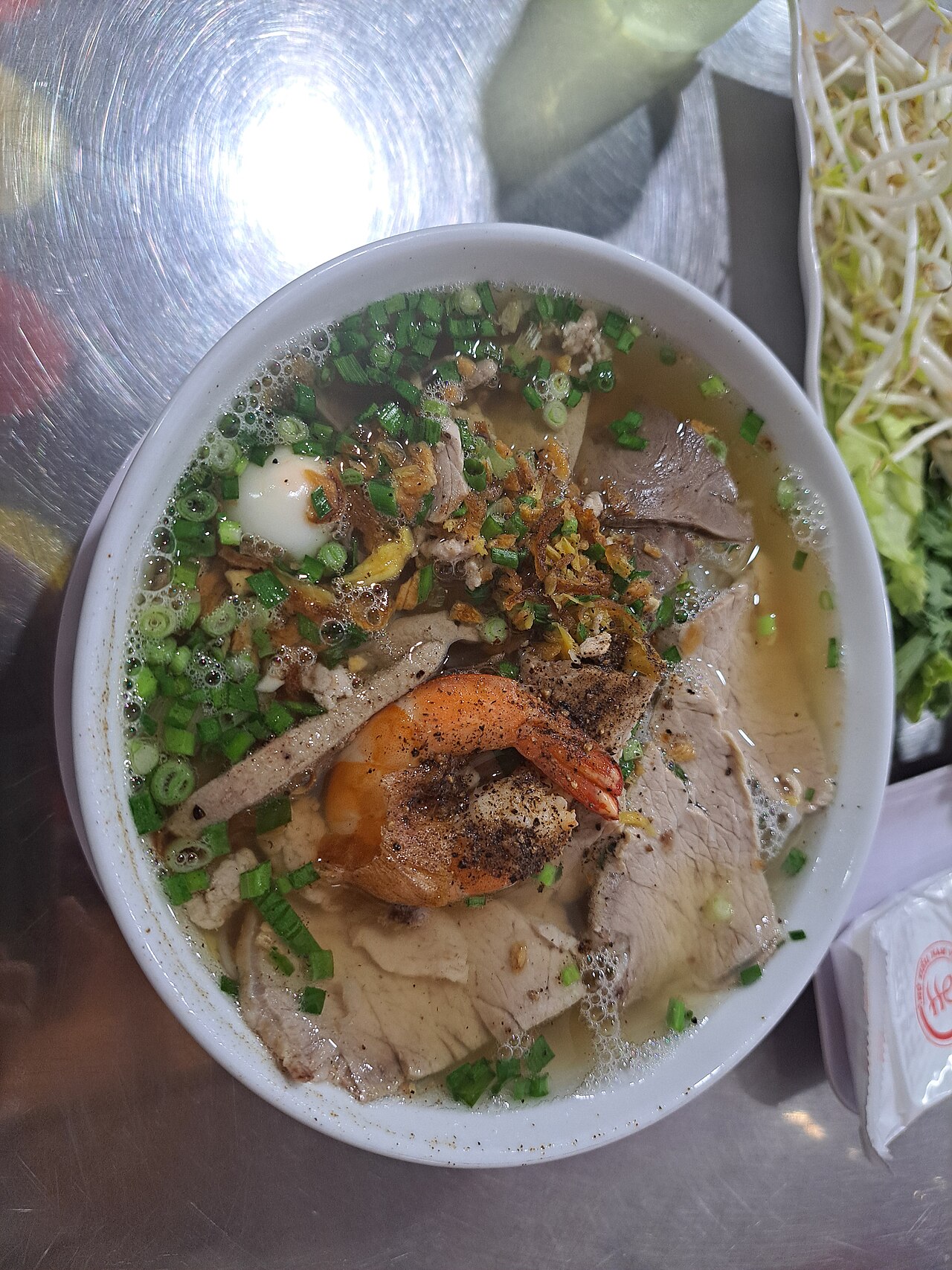
Shrimp, minced pork, and offal like pork liver and kidney float in the broth, while the noodles soak up all that savory richness — hủ tiếu Nam Vang is a noodle soup you'll find only in Ho Chi Minh City; Hanoi barely serves it at all. The name itself tells the story: Nam Vang is the Vietnamese name for Phnom Penh, Cambodia's capital — this bowl crossed the sea and was then reinvented by Chợ Lớn's Chinese community into a southern-only delicacy.
History and lineage: where Nam Vang noodle soup comes from
The "Nam Vang" in hủ tiếu Nam Vang is the Vietnamese name for Cambodia's capital, Phnom Penh. This noodle dish arrived in Saigon with Cambodian-Chinese immigrants, and was then adapted by the Chinese community in Chợ Lớn (District 5's Chinatown) to suit local taste — the broth became richer in the Chinese-style simmering tradition, with shrimp, minced pork, and offal like liver and kidney added in, evolving into the version commonly seen on Ho Chi Minh City streets today.
This noodle soup is a southern Vietnam exclusive — you'll rarely find it in Hanoi. It's often lumped together with hủ tiếu Mỹ Tho, but the two are actually distinct southern lineages: Nam Vang has a richer broth with generous offal toppings, while Mỹ Tho leans toward a lighter, sweeter broth, with different noodle thickness and flavor profiles. This guide covers them as two separate entries.
How to eat it like a local
Anchor restaurant and other classics
The anchor restaurant, Hủ Tiếu Nam Vang Liến Húa, sits on Võ Văn Tần Street in District 3 and is widely recognized by mainstream local media as a benchmark old-timer. Its broth leans into the richer Chinese-style simmering without overwhelming the other flavors — a reliable choice if you want to taste the essence of this dish in one bowl.
Other districts across the city have their own devoted Nam Vang noodle soup followings too — if you're staying in District 1 or District 10, nearby alleys will have decades-old stalls doing much the same thing, so feel free to just pick whichever is closest.
Practical info
Prices and hours (verified July 2026)
- Prices range from about 30,000–130,000 VND (roughly NT$37–159); a regular bowl usually falls between 60,000–90,000 VND (roughly NT$73–110), with offal or specialty versions costing more.
- Liến Húa is generally open daily from around 8am to 11pm, making it a good option for both lunch and late-night eats.
Local know-how
- One phrase to order: "Cho tôi một tô hủ tiếu Nam Vang đặc biệt" (One special Nam Vang noodle soup, please).
- This is a southern-only dish that's nearly impossible to find in Hanoi — worth trying while you're in Ho Chi Minh City.
- It's a different lineage from Mỹ Tho noodle soup, so it's worth confirming which style a shop specializes in before ordering, so you know what to expect.
Compiled from Vietnam's official tourism website, English-language local media like Saigoneer, and several lifestyle platforms. Broth-style distinctions are based on information verified in July 2026.