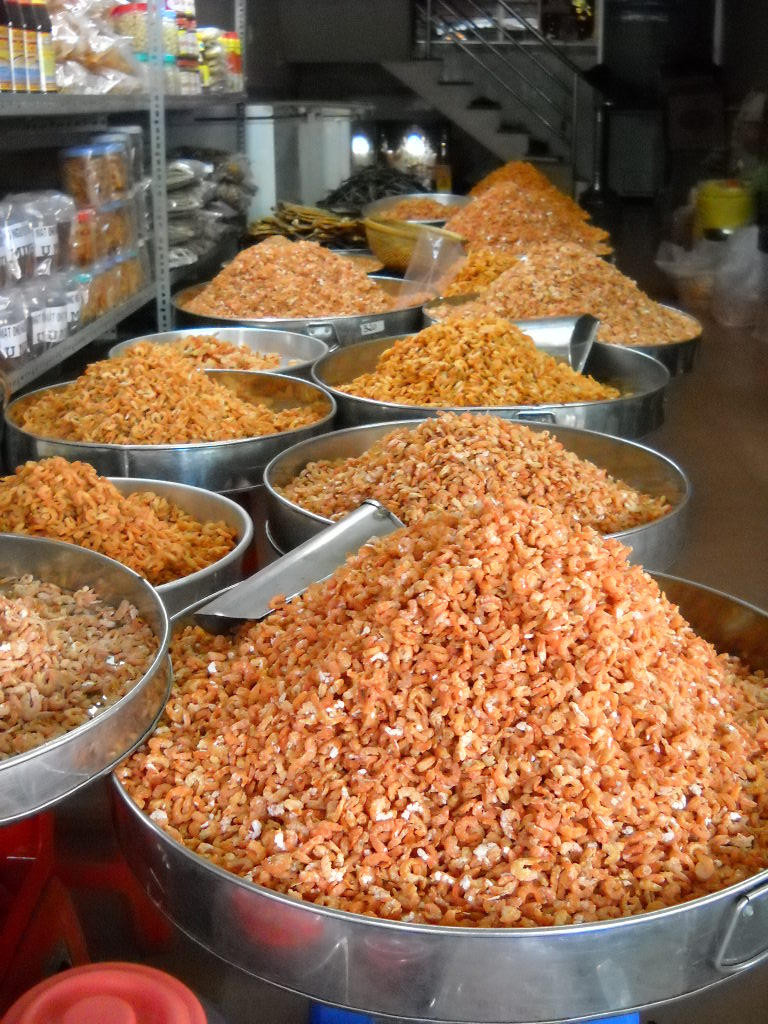
Glass jars at the souvenir shop are piled high with orange-red dried shrimp -- peel off the thin shell and bite in for a savory-sweet taste. This drying craft has been passed down for over a century, certified with a collective trademark in 2011, and it's the flavor visitors most associate with Ca Mau -- though its origin lies beyond the city, in Rach Goc town.
Cross-confirmed by government bodies, state media, and mainstream news as a century-old drying craft
Ca Mau's provincial Farmers' Union official website, the Ministry of Agriculture and Environment's official Vietnam Fisheries magazine, and VnExpress cross-confirm that the National Office of Intellectual Property approved the "Tom kho Rach Goc" collective trademark on July 8, 2011, held by Ngoc Hien district's Farmers' Union. The district's mangrove shrimp-pond farming area spans about 21,000 hectares, and the drying craft has over a century of history -- the shrimp, sun-dried, turns savory and sweet, a province-wide representative souvenir.
Honest clarification: the core production area is Rach Goc town in Ngoc Hien district, not within the city; judged not a duplicate of the same town's fermented crab
It has to be said honestly that the core production area is Rach Goc town under Ngoc Hien district -- not within Ca Mau City's own territory, where the city mainly functions as a market and souvenir retail hub. This item shares its geography with the already-listed "Ba khia Rach Goc" from the same town -- one a fermented crab, the other a dried shrimp, each with its own independent sourcing and craft. This entry judges them not to be a duplicate, while honestly disclosing that both come from Rach Goc town despite being different items.
How to Buy It Like a Local
- Widely sold at markets and souvenir shops across Ca Mau City in packaged form, good for buying by weight.
- When buying, check whether the shrimp is a bright orange-red color -- too pale or too dark may not be fresh-season stock.
- To trace the true farming and drying area, plan a trip out to Rach Goc town in Ngoc Hien district.
An Honest Look at This Dried Shrimp's Origins
- The collective trademark explicitly records the holder as Ngoc Hien district's Farmers' Union -- the core production area is not within Ca Mau City's own territory.
- This item shares geography with the already-listed "Ba khia Rach Goc" fermented crab from the same town, but the two are different items -- judged not a duplicate.
- The city is the main point of sale, not where the shrimp is farmed and dried.
Peel open an orange-red dried shrimp and a savory-sweet taste unfolds in the mouth. Behind that flavor is the shrimp-farming and drying households of Rach Goc town in Ngoc Hien district, keeping a craft alive without interruption for over a century.