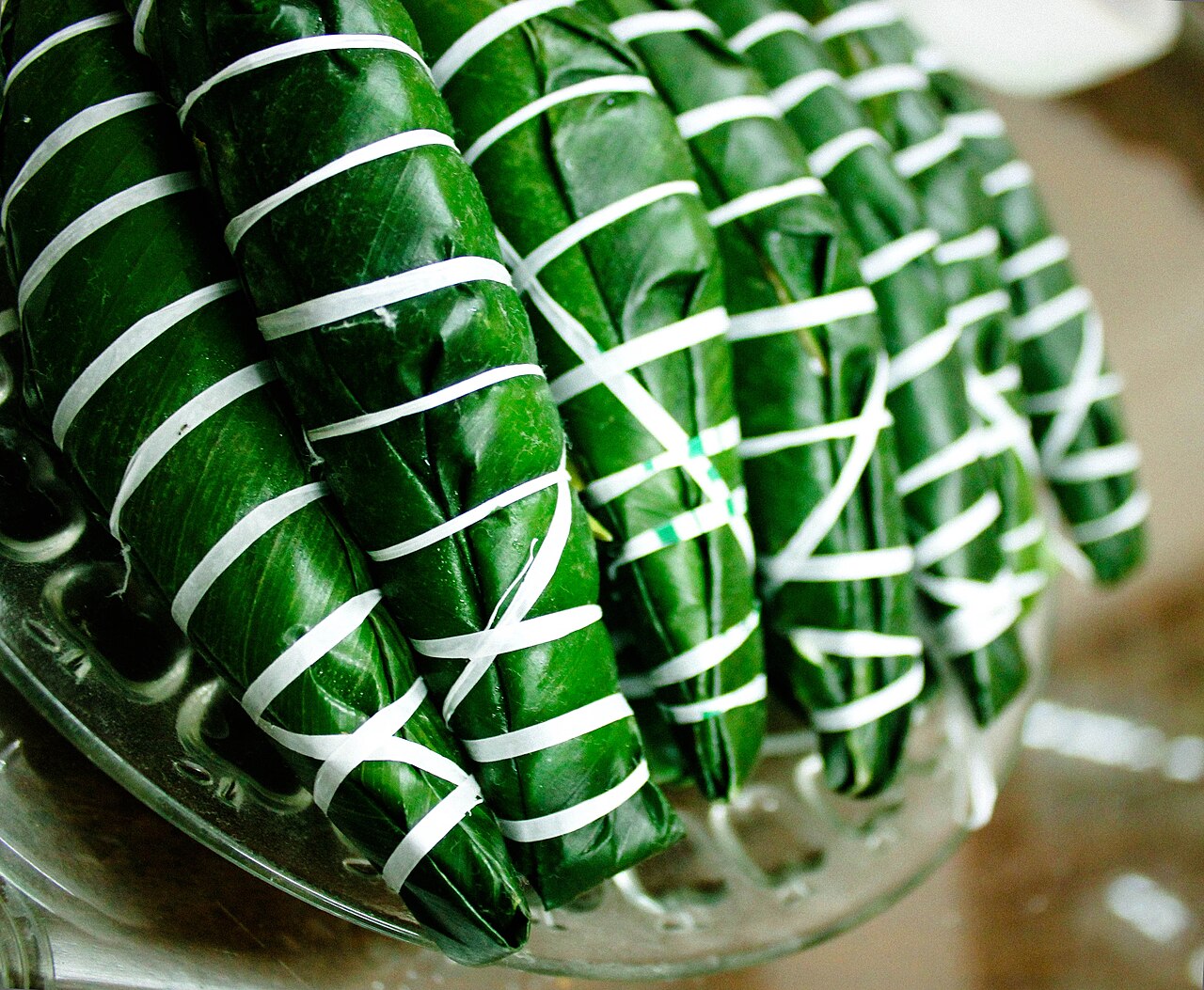
At a souvenir shop, log-shaped cakes wrapped in dong leaf sit lined up on a shelf; peel back the thin, translucent rice skin and the aroma of pork and wood ear mushroom rises up. This is a century-old craft carried on in Chờ town, only formally certified as a Bắc Ninh Province OCOP product in 2021 -- but its name is often mistaken for a generic snack found all over Vietnam.
Cross-confirmed by Nhân Dân, the Ministry of Industry and Trade, and a 2021 OCOP certification as a Chờ town craft
Nhân Dân (nhandan.vn, the central organ of the Communist Party of Vietnam), the Ministry of Industry and Trade's border-and-highland-products promotion website (thuongmaibiengioimiennui.gov.vn), and a 2021 Bắc Ninh Province OCOP product certification cross-confirm this dish. It's a small, thin-skinned sticky-rice log wrapped in dong leaf, filled with pork, wood ear mushroom, and pepper, explicitly located in Chờ town, Yên Phong district, with around 20 producing families still active.
Honest clarification: not the same origin as bánh tẻ elsewhere, and true origin is Yên Phong district
It has to be said honestly that the true origin is Chờ town, Yên Phong district, not within Bắc Ninh City's own territory. This entry's anchor is placed instead at a representative souvenir-shop and gift-market location confirmed within the city, honestly disclosing this rather than overstating the dish as a Bắc Ninh City original. Additionally, the name "bánh tẻ" also refers to a similar category found around Thanh Hóa and north-central Vietnam, but this entry's basis for inclusion isn't a generic reference to bánh tẻ found anywhere -- it rests firmly on Chờ town's specific century-old producing community and its 2021 OCOP brand certification, both explicitly named in sources. This entry doesn't conflate it with the Thanh Hóa version.
How to Eat It Like a Local
- Widely available at central souvenir shops and gift markets in Bắc Ninh City.
- The traditional way to eat it is peeling back the dong leaf and eating it whole, with a thin rice skin and a pork-and-mushroom aroma.
- To see the actual century-old producing families, plan a trip out to Chờ town in Yên Phong district.
An Honest Look at This Rice Log's Origins
- The true origin is Chờ town, Yên Phong district, not within Bắc Ninh City's own territory -- this entry's anchor uses a city-territory point of sale instead.
- Although the name matches bánh tẻ found around Thanh Hóa and north-central Vietnam, this entry's identity rests on Chờ town's specific community and its 2021 OCOP certification.
- Sources explicitly name this location -- this entry doesn't treat it as a generic reference to bánh tẻ found across Vietnam.
Peel back the leaf on a rice log and the aroma of pork and wood ear mushroom rushes out from under the thin skin -- the name might sound familiar elsewhere, but the craft in those roughly 20 families' hands in Chờ town only earned its official certification stamp in 2021.