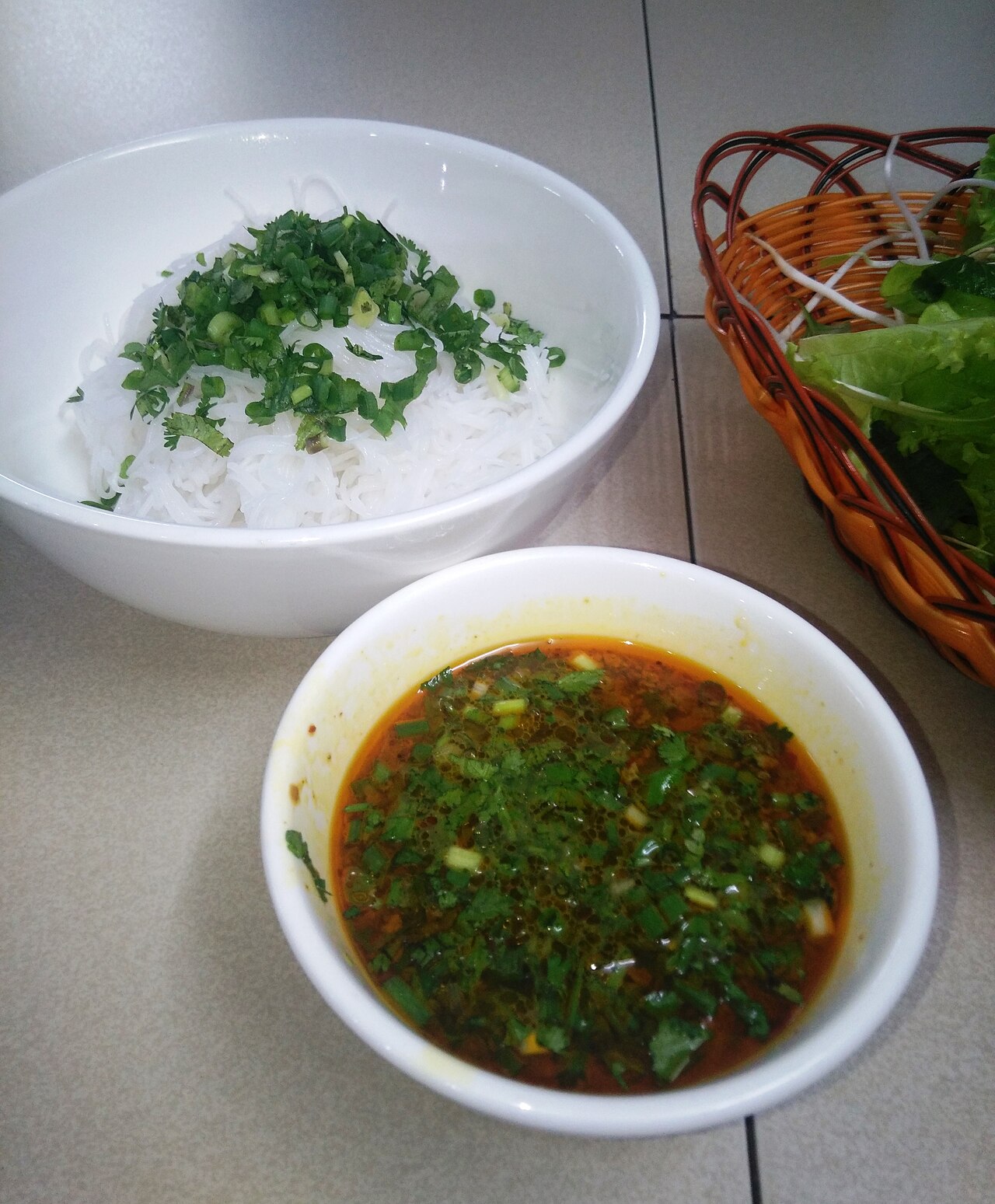
Only after a customer orders does the shop ladle freshly made fish-and-shrimp paste into a bowl, then pour in boiling water and stir it quickly with chopsticks until cooked — this is bún quậy, the most memorable bowl of noodles around Dinh Cau Temple on Phu Quoc. 'Quậy' itself means to stir or to make a commotion, and the way it's eaten is a small performance in itself.
A Phu Quoc specialty cross-referenced by multiple state and mainstream media
Two VnExpress Du Lịch features, 'Bún 'quậy' Phú Quốc' and 'Bún quậy Phú Quốc - món không phải có tiền là ăn được,' plus a feature from the state broadcaster VOV, 'Bún quậy – món ăn trứ danh từ đảo Ngọc Phú Quốc,' all list this dish as one of Phu Quoc's representative specialties. Quán Kiến Xây, near Dinh Cau Temple, is documented across multiple independent reports as the earliest shop to sell this dish on Phu Quoc, making it the most commonly cited anchor point when tracing the dish's history. The method involves the shop making fish-and-shrimp paste in advance, then, once a customer orders, pouring boiling water into the bowl and stirring it right at the table — this 'order-then-stir' style of eating is where the name bún quậy comes from.
Honest clarification: not native to Phu Quoc — it's a fusion dish from central Vietnamese migrants
It has to be said honestly, according to reporting from Dân Việt, that bún quậy isn't a dish that's been passed down on Phu Quoc since ancient times. Its prototype actually comes from bún tôm, a shrimp noodle dish from Bình Định province in central Vietnam, brought to Phu Quoc by Bình Định migrants around 1995-1996, and only developed its distinctive tableside-stirring method after being adapted locally. In other words, this is a product of migrant food fusion, roughly 30 years old — not a centuries-old Phu Quoc original, and that's worth stating plainly rather than inventing an older backstory for it.
How to Eat It Best
- The tableside stirring is the soul of this dish — order, then wait at your seat rather than stepping away.
- Stir it thoroughly and quickly once the boiling water is poured in, so the fish-and-shrimp paste is fully cooked before eating.
- A small dish of pepper and lime is usually served on the side to boost the flavor — add to taste.
An Honest Look at This Dish's Age
- Not passed down on Phu Quoc since ancient times — the prototype is bún tôm, a shrimp noodle dish from Bình Định province.
- Brought to Phu Quoc by Bình Định migrants around 1995-1996, where the tableside-stirring method was later developed.
- A product of migrant food fusion roughly 30 years old, not a centuries-old dish.
A bowl of table-stirred fish paste noodles isn't just about stirring boiling water into fish paste — it's a story of migrants carrying a taste of home to Phu Quoc and growing a new way of eating out of it. More than any claim of 'authenticity,' it's that story of fusion worth remembering with every hot, fresh bite.